
Special guest blog by Mercer Weis, a recent Stanford University graduate who studied Environmental Systems Engineering
My name is Mercer Weis, and I am a recent graduate from Stanford University with a B.S. in Environmental Systems Engineering. With the help of volunteers from Surfrider’s Blue Water Task Force (BWTF) in San Mateo County, we conducted a pilot study on how stormwater events influence fecal-indicator bacteria transport in Pacifica, CA. The results from our sampling efforts were astonishing, as there were surf zone water samples containing levels up to 134x the EPA’s threshold for enterococci, the fecal-indicator bacteria in question.
What we uncovered was murky to say the least.
Surfrider’s BWTF team in San Mateo County has previously discovered high levels of enterococcus bacteria levels (MPN/100mL), a known fecal indicator bacteria (FIB), in the San Pedro Creek, a river that spills into Linda Mar Beach in Pacifica, CA. However, water samples collected by the BWTF had not assessed the water quality of the surf zone in the broader coastal environment of Linda Mar. As designed in this pilot study, I studied whether stormwater pulses and specific tidal phases transported enterococcus bacteria past the mouth of the creek and further into the more active regions of Linda Mar.
This project built on prior work I conducted for my Civil & Environmental Engineering capstone project on the distribution of bacteria in San Pedro Creek during the spring of 2025, where one rain event and four non-rain events occurred. This study took place in the winter of 2026, during more rain events, to test the influence of stormwater and tides on bacteria transport past the freshwater ecosystem of San Pedro Creek.
Existing field research has shown a correlation between stormwater discharge and poor microbial water quality at various sites (Staley et al., 2018). Water samples that yield high enterococci levels after stormwater events have been linked to gastrointestinal infections that pose severe public health concerns for those swimming in freshwater environments (Wade, 2008). Even the presence of enterococci indicates that there may be fecal matter in the water containing other pathogens in addition to enterococci. For example, E. coli and salmonella, two other pathogens that pose adverse health risks, are found in water with high enterococci levels but are harder to detect because they are more sensitive to UV and salinity (Korajkic et al., 2013).
Samples with high enterococci levels surpass the Environmental Protection Agency’s (EPA) threshold of 104 MPN/100mL and are associated with an elevated risk of contracting UTIs, bacteremia, infective endocarditis, and other infections (Said et al., 2024). To advance research in methods of bacteria transport from freshwater to saltwater environments, I collected in-situ water samples along a transect line of four zones (Zone 0-3) spanning San Pedro Creek down to the surf zone of Linda Mar during five non-rain and three rain events to test the influence of storm pulses on enterococci levels.
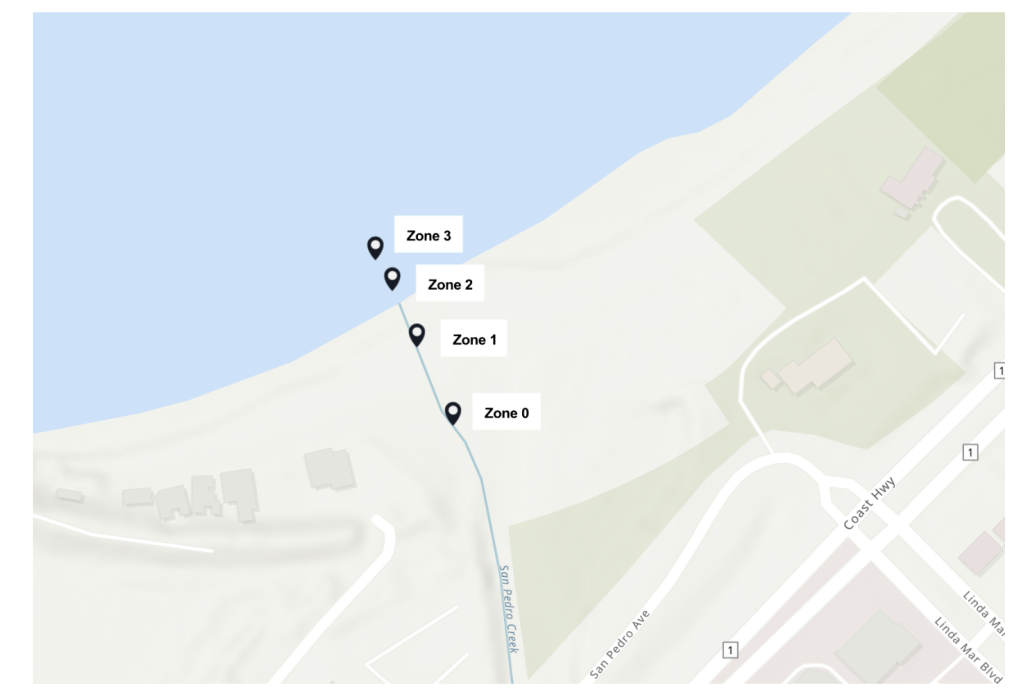
Figure 1: Location of all sampling sites (Zones 0-3) at Linda Mar Beach in Pacifica, CA
Results show that during non-rain events, enterococci levels (MPN/100ml) surpassed the EPA threshold 100% of the time, with values reaching as high as 479 MPN/100mL, approximately 4x the EPA threshold. During rain events, enterococci levels (MPN/100mL) reached as high as 14,136 MPN/100mL, approximately 136x the EPA threshold. While these are isolated values, a Spearman correlation test found a coefficient of 0.71 between radar-estimated rain intensity and enterococci values, indicating a positive correlation between stormwater and high enterococci values. Additionally, enterococci values on three of the four rain periods surpassed the EPA threshold in the saline environments of Zone 2 and Zone 3.
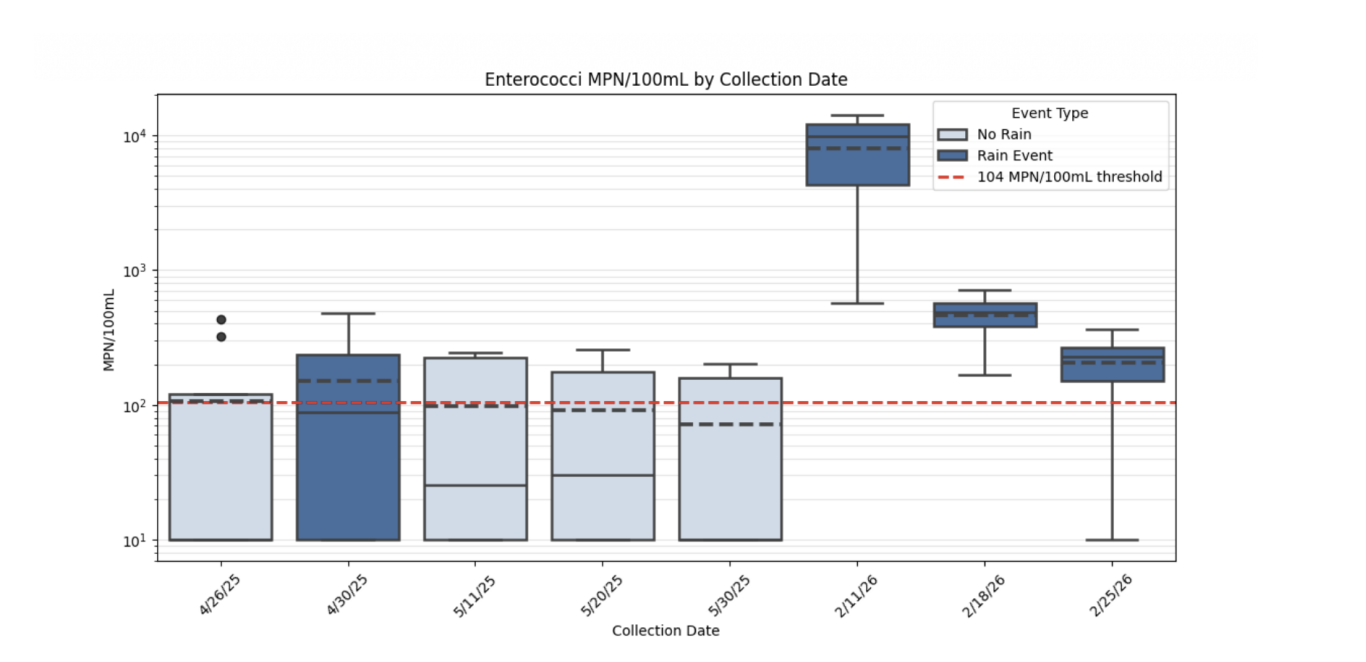
Figure 3.6: Distribution of enterococci values (MPN/100mL) across all collection dates, including both capstone and thesis dates listed in methods. Box plots colored based on "No Rain" or "Rain Event" periods.
Tides, however, did not demonstrate as strong of statistical significance as stormwater. Zone 3 exhibited higher median enterococci concentrations during falling tides compared to rising tides, suggesting a possible tidal export effect. However, this difference was not statistically significant.
Findings from this research demonstrate urgent trends in enterococci's presence in saltwater environments like those in Pacifica, CA. To address these bacteria plumes, green stormwater infrastructure projects can remediate waters by slowing stormwater runoff and naturally filtering flows. Low-cost options include vegetated detention basins or enhancing riparian vegetation before the start of the transect line (Zone 0). Both of these methods use native wetland vegetation to collect stormwater with high enterococci levels and filter the water by either resuspending particles physically into sediment or halting water flows to allow UV to hinder enterococci growth (Diaz, 2010).
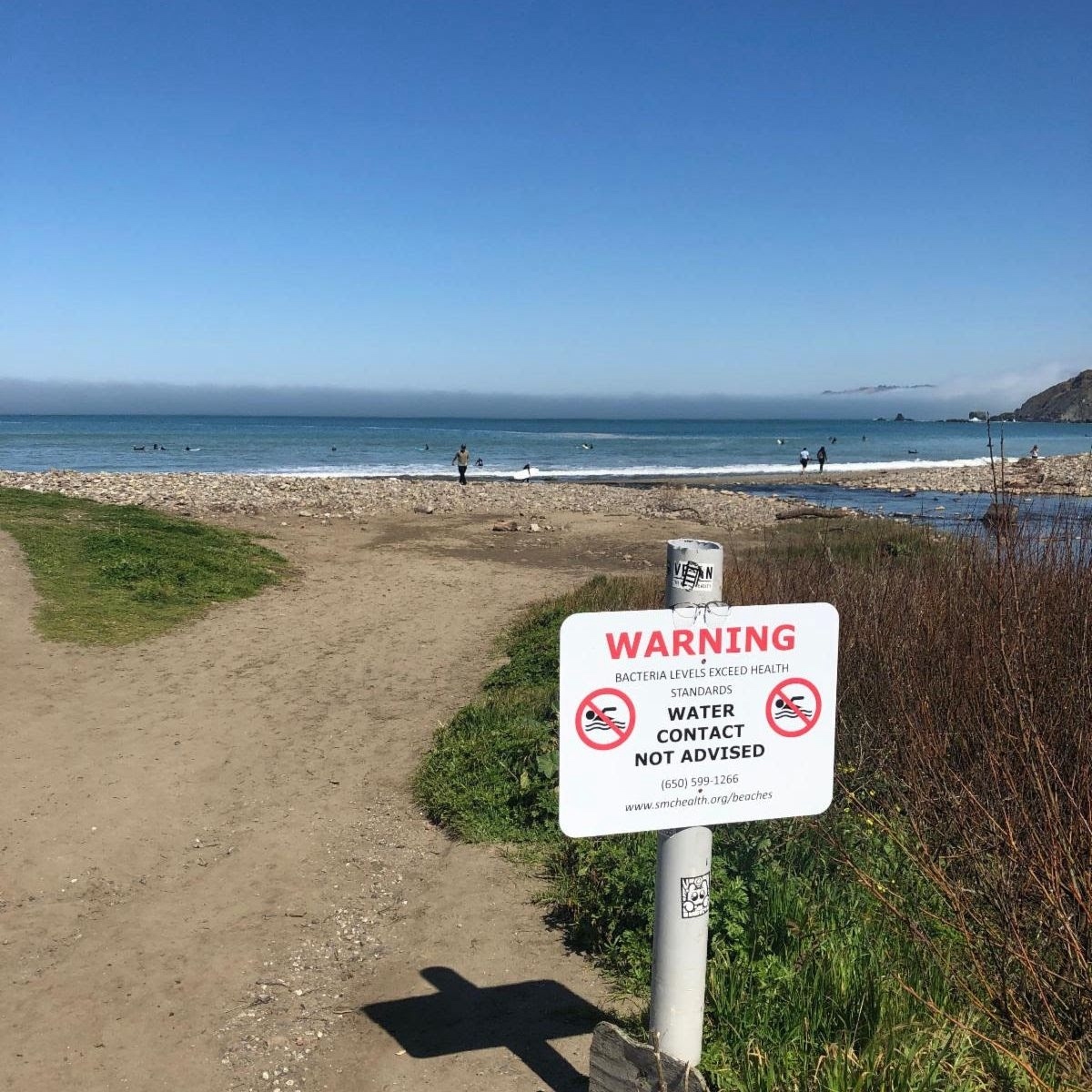
Additionally, these findings emphasize the need for more routine testing and tracking. Establishing a consistent public health advisory program for Linda Mar is needed to keep recreational surfers and swimmers more aware of local water quality. Signage at the beach is currently outdated and static, lacking any official public health advisory program that actively updates the sign with water quality levels. It is imperative that stakeholders, including city officials, the Surfrider Foundation, and local beach advocates, all collaborate on public health practices that can best keep swimmers and surfers informed of up-to-date enterococci levels and how stormwater can especially amplify enterococci levels days after a rain event.
You can read Mercer's complete Honors Thesis here and check out his presentation here.