
This blog was written by UCSC students in ENVS-150 Coastal & Marine Policy:
Ariel Anderson, Zaara Asnani, Angelina Cripe, and Cade Kelton.
Why Us UCSC Students Care About San Mateo Water Quality
Involving ourselves with the Blue Water Task Force and the issues occurring in San Mateo County beaches applies to us in the same way that it applies to many other members of the community: we want to see our beaches and oceans thrive, and we want to see policies that reflect and support those desires. By finding ways to educate ourselves on relevant water quality issues and suggesting ways to help move forward in solving them, we hope to encourage the community to realize that caring about the ocean and the health of its beaches is important to all aspects of life.
About Us
We are four undergraduate students enrolled in the course, "Coastal and Marine Policy" at the University of California, Santa Cruz. This quarter we were tasked with collaborating with a community organization in our area to complete a project relating to the themes of coastal and marine policy. The four members of our group- Ariel, Zaara, Angelina, and Cade- all intentionally chose the Surfrider Foundation to partner with, out of our own personal interests. We are all avid beach goers, as students who live in the city of Santa Cruz, known for its beautiful beaches and coastal bluffs. We also believe in equal access to beaches as well as clean ocean waters to swim in. Recognizing the privilege of living in a coastal area of California, means recognizing that there are steps to take in order to ensure these natural public spaces maintain their health and beauty. Our group members also all possess a strong interest in environmental related issues as a whole, and the importance of preserving the environment for current and future generations.
Upon reading the description of the Surfrider Foundation and the work we would be doing, it all sounded very intriguing and a valuable project to be a part of. Our project explored the public health concerns around beaches and the role of local governments and non-profits in mitigating them. The four members of our group worked closely with two of Surfrider's members-Sara and Jaime- over the duration of 7 weeks. It was wonderful collaborating with two leaders of the Surfrider Foundation and learning more about the organization's work.
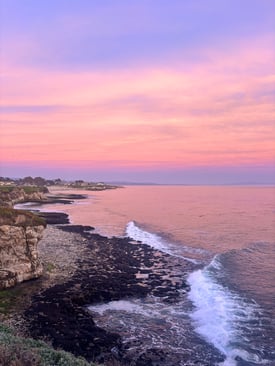
Photo of the coastal bluffs in Santa Cruz, taken by Ariel Anderson
3 Key Takeaways
To summarize some of the major themes throughout this project, we have included 3 key takeaways within our work that are important to note.
1. Importance of providing easy access to information
Throughout this project, a main focus was creating infographics and information that was easily digestible and accessible to everyone. Most of the data that Surfrider and the Blue Water Task Force collects is for the public. But, a lot of information within Surfrider's data is not public knowledge. For example, the measurements of enteroccocus bacteria and what certain numbers of bacteria levels mean, is not a well known phenomenon. That is why explaining certain information in a simplistic and understandable way is crucial in order to get the message across and keep audiences engaged.
Emphasis on including QR codes in our infographics was a key concept in creating these deliverables as some of the infographics we made would be displayed at public events where people might want to learn more information. By having these accessible links on display, it is an easy way to provide quick access to important information. To see the other infographics our group created, check out the "Our Report" section at the bottom of this webpage.


2. Addressing Next Steps for Limiting Water Pollution
Stormwater runoff is a common cause of pathogens spread into coastal waters. Evaluating current stormwater drainage systems in San Mateo County and potentially implementing faster stormwater treatments such as native plant filtration systems, can be a cost-effective method to limit pollution and uncover current drainage issues. Another method to limit water pollution is through sand dune infiltration systems, utilizing the existing sand dune landscapes which can effectively reduce pathogen infiltration through natural filtration. Lastly, by mapping horse facilities in San Mateo County, this would reveal and rule out fecal contamination areas as a source of pathogen spreading into waterways.
3. Blue Water Task Force Testing
Our project was to look at two different entities conducting water quality testing in San Mateo County, to compare the two methods, look for patterns in the data, and develop four communication pieces to be used to educate the public about water quality concerns. The two entities that conduct water quality testing in San Mateo are the San Mateo County Department of Health and the Blue Water Task Force which is Surfrider’s volunteer water quality monitoring program. This brings up the question of public access! Even if the beaches are physically accessible, closures and warnings due to high bacteria play a huge role in how people experience the coast.
Learn more about the Blue Water Task Force
Our Report
For more information on our groups' deliverables and the work completed during this project, check out our report which consists of a comparative analysis of water quality testing measures between the Surfrider Foundation and the San Mateo County Health Department, a detailed report on the causes and potential solutions to water quality challenges in San Mateo County, and additional information on our communication pieces.